18 Jun 2026
Mapping Seasonal Form Cycles to Refine Accumulator Selections Across Football Leagues and Flat Racing Circuits
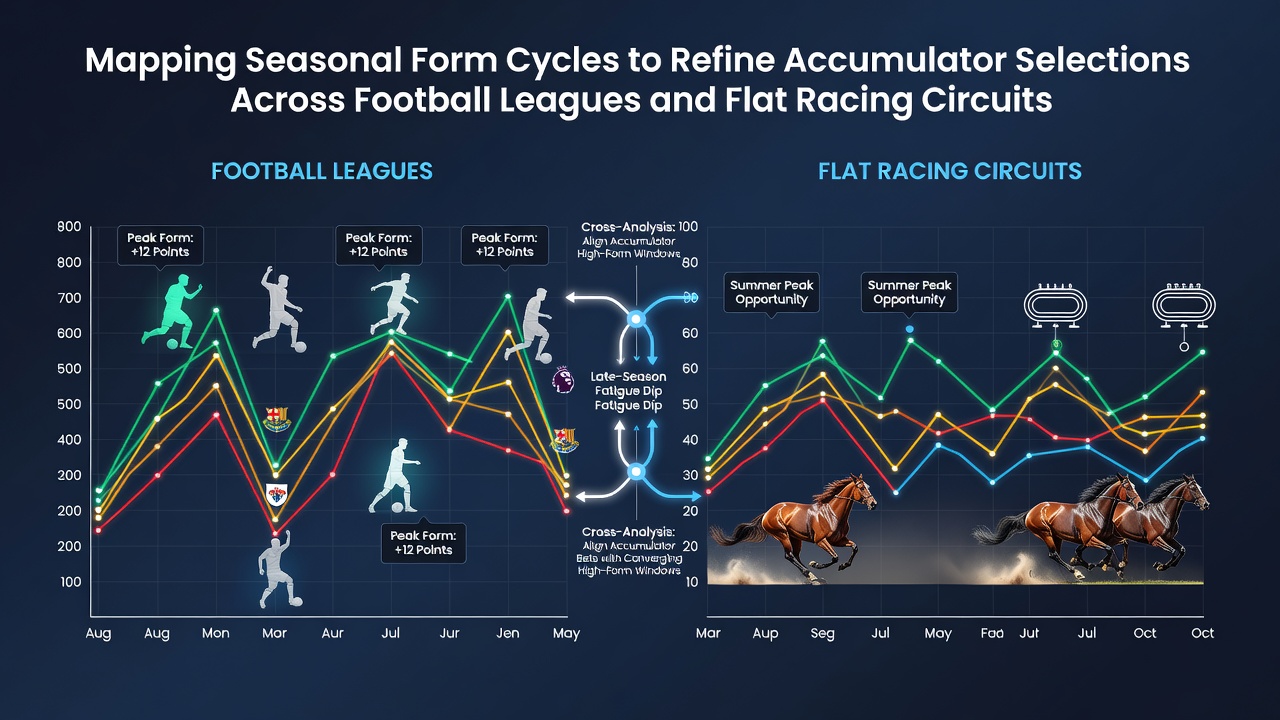
Seasonal form cycles shape outcomes in both football leagues and flat racing circuits because teams and horses respond to weather shifts, fixture density, and training adjustments that repeat each year. Observers note that early-season data often reveals different patterns than mid-campaign results, while late-season fatigue or motivation changes alter performance baselines in measurable ways. Data from multiple European and Australian racing authorities indicates that these recurring cycles provide measurable edges when selectors build accumulators that span both sports.
Football League Patterns Across Calendar Quarters
Football leagues operate on a September-to-May core window in most European competitions, yet form fluctuates within that window because of pre-season conditioning loads and mid-winter fixture congestion. Studies compiled by university sports analytics programs show that teams in northern leagues post lower expected goal totals during December and January compared with September baselines, whereas southern European sides maintain steadier outputs across the same months. Accumulator builders who track these quarterly shifts can weight selections toward sides that historically improve after the winter break rather than those that peak early.
June 2026 sits in the off-season for major European leagues, yet analysts already map pre-season friendlies and training data to forecast August trends. Research indicates that squads investing extra weeks in high-altitude camps during June demonstrate measurable improvements in early-season pressing metrics, a pattern repeated across multiple campaigns. Those who incorporate such preparatory signals into accumulator planning gain an information advantage before the first league fixtures begin.
Flat Racing Cycles on European and Australasian Circuits
Flat racing circuits follow distinct seasonal calendars that intersect only partially with football schedules. European tracks peak from May through September, while Australian and New Zealand circuits operate their premier events between September and March. Performance databases maintained by regional racing boards reveal that horses returning from winter spells post higher win rates in their first three starts of the new campaign when those starts occur on tracks matching their preferred going. Accumulator selectors who align these equine cycles with football selections can stagger bets across calendar months when one sport's form signals strengthen while the other's weaken.
Combining Data Streams for Multi-Sport Accumulators
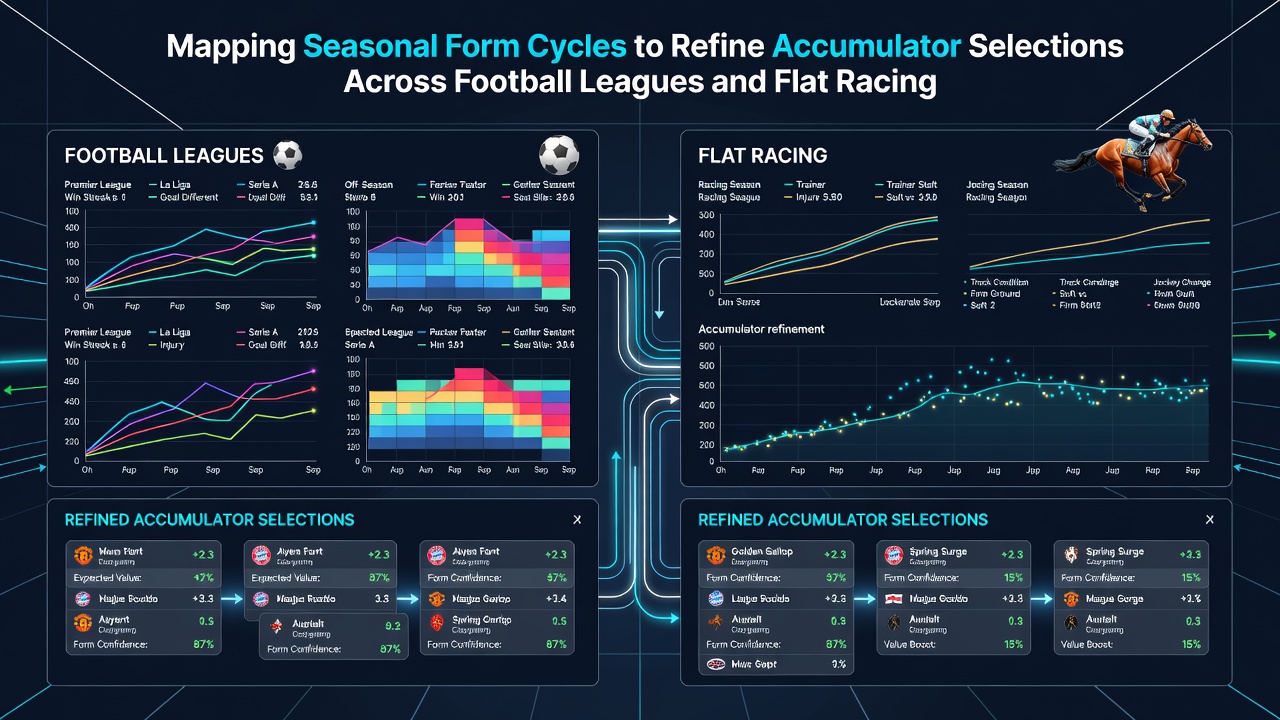
Mapping tools now merge league table momentum indicators with horse rating adjustments that account for seasonal weight allowances and track biases. Industry reports from North American and European data providers demonstrate that combined models reduce variance in accumulator strike rates compared with single-sport selections. The process begins with identification of recurring form troughs, such as post-international-break dips in football or post-travel slumps in racing, then layers positive counter-cycles from the alternate sport.
One documented case involved selectors who avoided football teams returning from mid-season breaks in March while favoring flat runners at tracks hosting spring festivals, producing consistent multi-leg returns over successive seasons. Data shows these adjustments work because the underlying biological and scheduling factors remain stable year after year, even as individual participants change.
Regional Regulatory Context and Data Availability
Access to granular form data has expanded since several jurisdictions updated disclosure rules for sports and racing statistics. According to reports issued by the Australian Competition and Consumer Commission and the Canadian Pari-Mutuel Agency, public datasets now include detailed seasonal splits that were previously restricted. European research consortia have similarly released anonymized performance files covering both football and thoroughbred racing, enabling independent verification of cycle patterns without reliance on single national regulators.
These expanded sources allow selectors to test hypotheses across multiple seasons rather than relying on anecdotal observation. Figures released by the New Zealand Racing Board, for instance, confirm that horses aged four and five exhibit stronger seasonal improvement curves than older runners when campaigns begin in southern hemisphere spring. Parallel football datasets show comparable age-related recovery patterns among squads after summer breaks.
Practical Application in Accumulator Construction
Selectors begin by charting each sport's historical form peaks on a shared timeline, then identify months where positive signals overlap. In June 2026 the northern racing season reaches full stride while football pre-season testing intensifies, creating a narrow window where both datasets refresh simultaneously. Accumulators built during this period can draw early indicators from both domains before major competitions resume.
Longer sentences help illustrate the layered decision process because selectors must weigh fixture difficulty, travel distance, surface changes, and squad rotation policies at once. Yet the underlying principle stays straightforward: identify stable seasonal rhythms, then place selections only when multiple cycles align in the same direction.
Conclusion
Seasonal form mapping supplies a repeatable framework for refining accumulator selections because the environmental and scheduling drivers behind performance shifts persist across campaigns. Data from diverse regulatory and academic sources across Australia, Canada, New Zealand, and Europe supports the use of these cycles in both football and flat racing contexts. As datasets continue to grow in granularity, selectors gain additional precision without altering the core method of aligning positive periods across the two sports.