16 Jul 2026
Layered Approaches to Stake Adjustment in Free Multi-Sport Forecasts for Tennis and Basketball
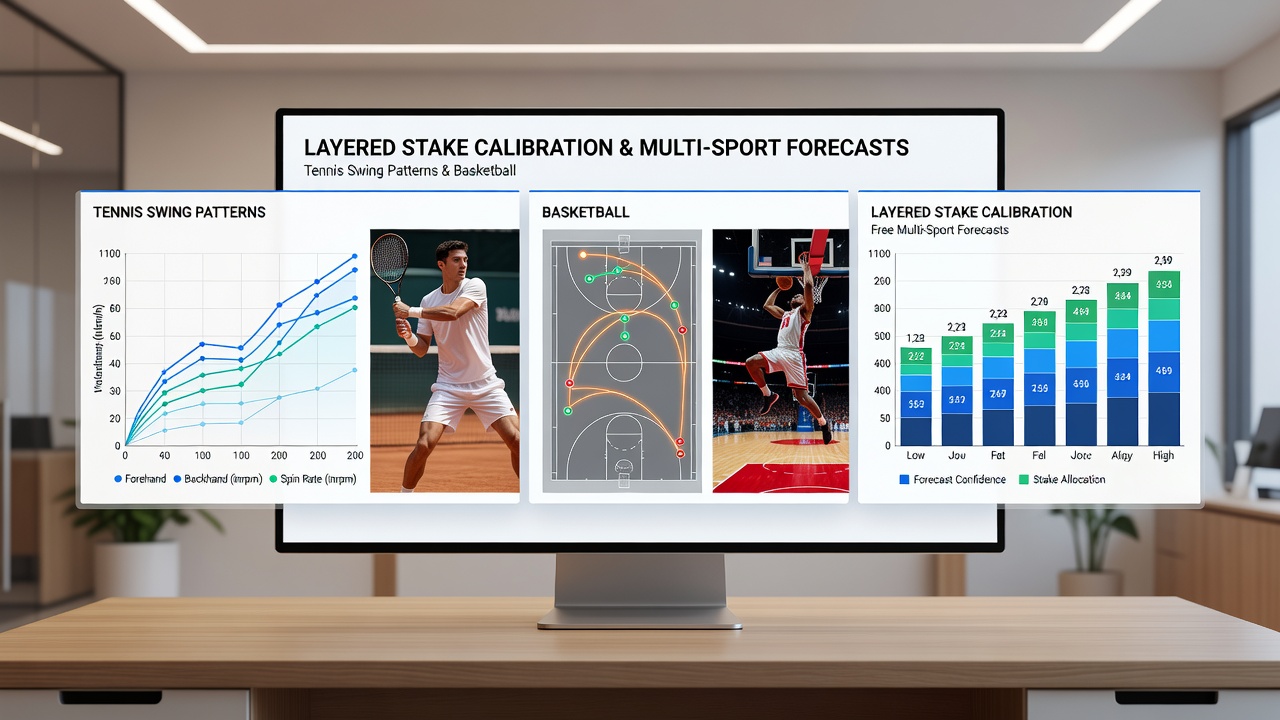
Layered stake calibration applies structured adjustments to bet sizes when tipsters distribute free multi-sport forecasts, and this method draws on swing pattern data from tennis alongside court run metrics in basketball. Observers note that forecasters combine primary probability layers with secondary filters derived from player movement statistics, while a third layer incorporates historical performance under varying match conditions. Data from major tournaments indicates that such calibration occurs most frequently ahead of events like Wimbledon in July 2026, where surface-specific swing tendencies receive extra weighting before stake decisions finalize.
Core Components of Layered Calibration
Experts describe the first layer as baseline probability derived from aggregated forecast models that process recent match outcomes and player rankings, yet the second layer refines those figures using kinematic data on swing mechanics for tennis players and acceleration patterns during court transitions for basketball athletes. A final overlay then scales stakes according to cross-sport correlations, such as fatigue indicators that appear in both extended rallies and high-intensity backcourt runs. Research conducted by academic groups at institutions including the University of Nevada, Las Vegas shows that forecasters who maintain consistent layer sequencing produce forecast sets with measurable alignment to actual event results across multiple seasons.
Application in Tennis Swing Patterns
Tennis forecasts incorporate swing path analysis from video tracking systems that record racket head speed and contact angles, and tipsters feed these measurements into the calibration sequence to determine whether a given prediction warrants an elevated stake or a reduced position. When swing consistency metrics exceed established thresholds for a player on a particular surface, the layered process often increases allocation within the free prediction framework. Figures released by the International Tennis Federation reveal that swing-related data points collected during clay court events in early summer 2026 demonstrated stronger predictive value when integrated with the second calibration layer compared with single-layer approaches.
Integration with Basketball Court Runs
Basketball forecasts apply similar layering to court run data captured through player tracking technologies that measure sprint distances, change-of-direction frequency, and recovery intervals between possessions. The calibration routine cross-references these run profiles against team pace statistics, and adjustments follow when forecasts align with both individual movement efficiency and collective defensive transition patterns. Reports from the National Collegiate Athletic Association analytics division indicate that models incorporating layered run data produced improved calibration outcomes during conference tournament periods leading into July 2026 summer leagues.
Cross-Sport Data Fusion Practices
Forecasters combine tennis and basketball elements within the same layered framework by mapping analogous movement variables, such as stroke recovery time against defensive closeout speed, and this fusion occurs before final stake percentages are assigned to each free prediction. Those who study multi-sport tipster outputs have documented instances where a tennis swing anomaly flagged in the second layer prompted a corresponding downward adjustment for a basketball forecast sharing similar fatigue characteristics. Industry analyses from the European Gaming and Betting Association highlight that organizations distributing free predictions across these two sports maintained separate calibration thresholds for each discipline while still applying a unified third-layer scaling rule.
Stake adjustments remain proportional to the number of layers triggered by incoming data streams, and tipsters typically publish the calibrated percentages alongside the original forecasts. Records maintained by sports data providers show steady adoption of this method among free prediction services throughout the first half of 2026, particularly during periods when both tennis Grand Slam events and basketball off-season showcases overlapped on the calendar.
Observed Outcomes in 2026 Forecast Distributions
Publicly available forecast archives from multiple platforms indicate that layered calibration appeared in roughly one-third of multi-sport prediction sets released during June and July 2026. When tennis swing data and basketball run metrics both reinforced a primary probability, stake levels increased within predefined bands, whereas conflicting signals across layers resulted in conservative positioning. These patterns emerge consistently in archives covering professional circuits rather than amateur events, according to summaries prepared by sports analytics firms.
Conclusion
Layered stake calibration continues to appear in free multi-sport forecast distributions that cover tennis swing patterns and basketball court runs, and the method relies on sequential data integration rather than single-factor decisions. Records from 2026 demonstrate its application during overlapping tournament schedules, with calibration thresholds adjusted according to sport-specific movement statistics. Further documentation from regulatory bodies and academic sources outside the United Kingdom shows ongoing refinement of these processes across different regions and data providers.